PORTFOLIO ONESPARK BLOG ABOUT FAQ BOOK A SCOPE CALL
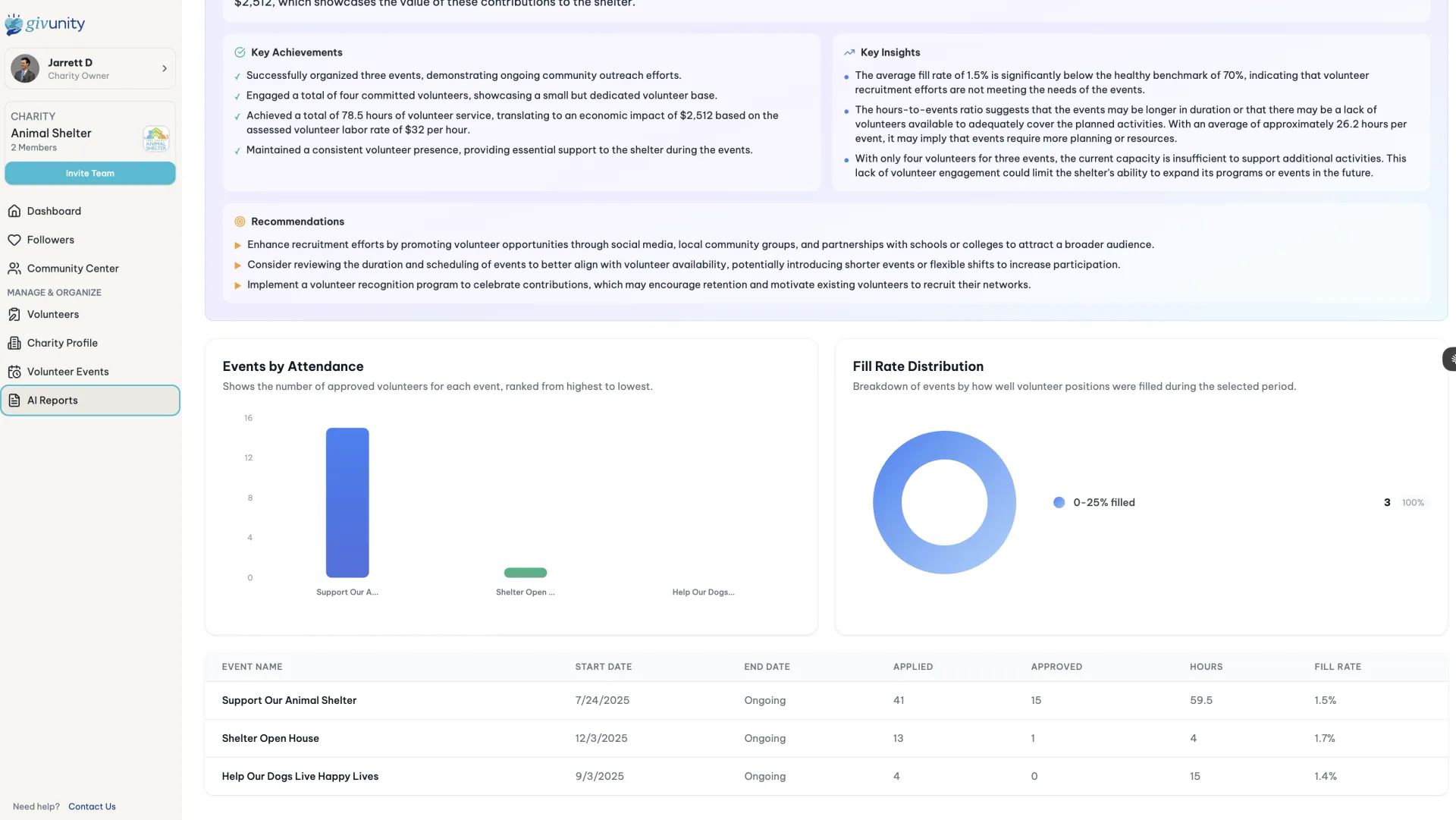
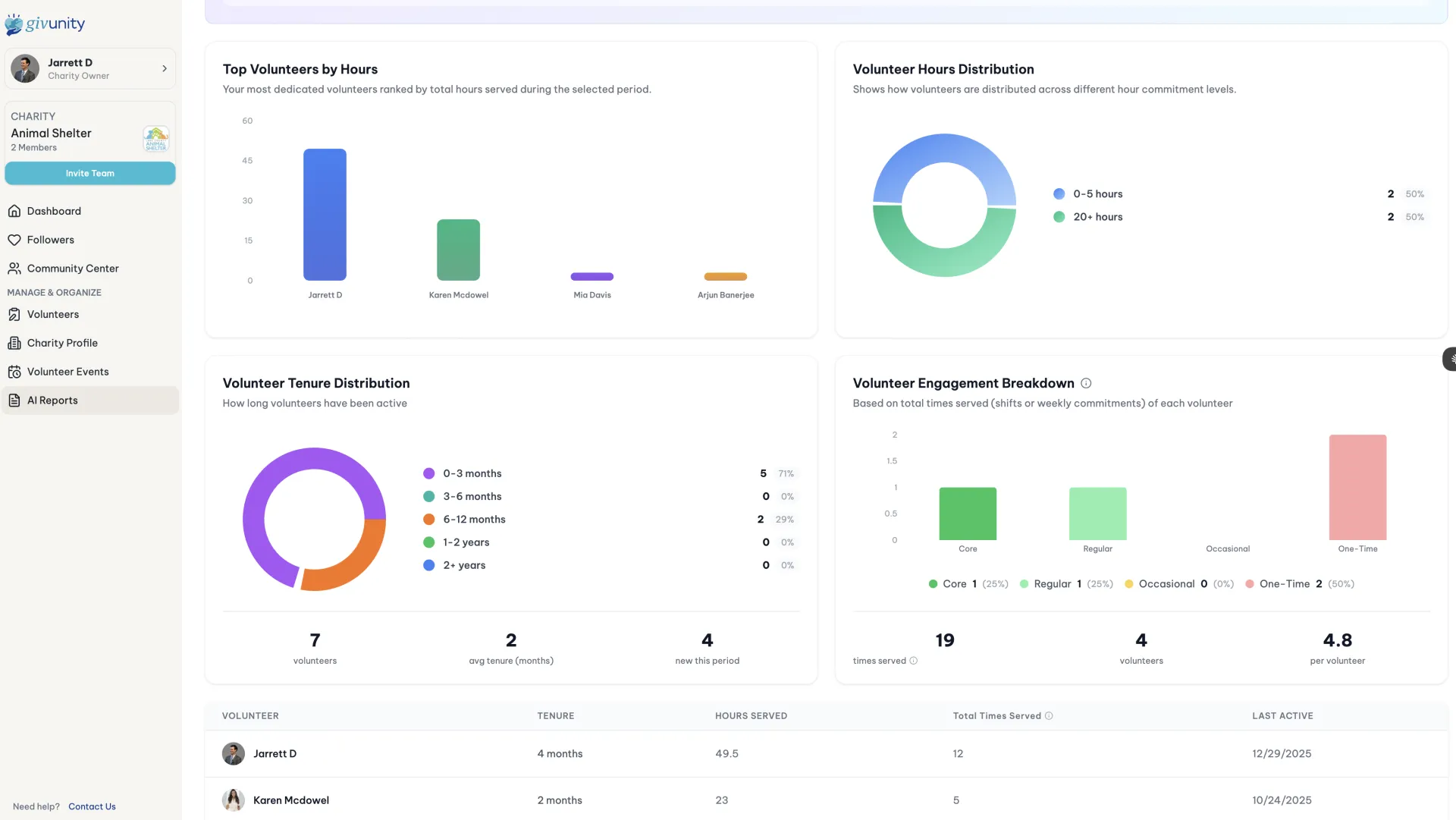
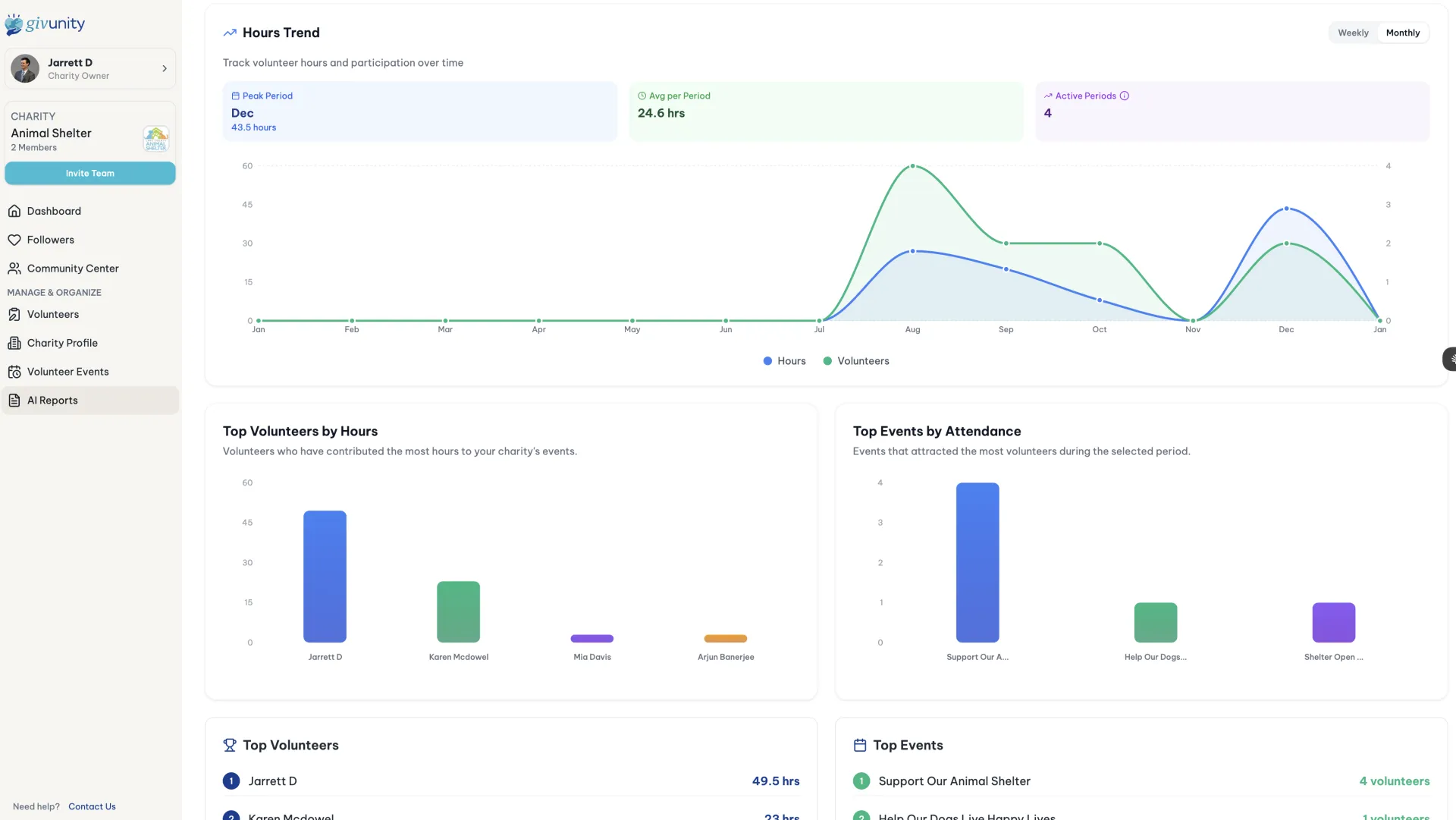
Givunity volunteer management dashboard with real-time coordinator view
NON-PROFIT

GIVUNITY

AI-powered volunteer management shipped 97% faster than traditional development

97% FASTER
400% ACTIVE USER GROWTH
1 MO CONCEPT TO PRODUCTION
$25K+ SAVED PER FEATURE

Givunity is an AI-powered volunteer management platform for nonprofits competing in a category dominated by legacy players like Volgistics, VolunteerHub, Better Impact, and Bloomerang Volunteer. OneChair partnered with Givunity to ship enterprise-grade features — AI volunteer analytics, an AI-assisted social media content builder, rich volunteer profiles with document management, and real-time collaboration — on a startup budget and timeline.

Tech Stack

Next.js 14 NestJS PostgreSQL Stripe Socket.IO OpenAI

Delivery Time

~1 month per major feature

Summary

Givunity is an AI-powered volunteer management platform for nonprofits, competing in a category dominated by legacy players like Volgistics, VolunteerHub, Better Impact, and Bloomerang Volunteer. OneChair partnered with Givunity to ship enterprise-grade features — AI volunteer analytics, an AI-assisted social media content builder, rich volunteer profiles with document management, and real-time collaboration — on a startup budget and timeline. Using AI-orchestrated development, OneChair compressed feature cycles from the industry-standard 4–6 months down to roughly 1 month per major release, letting a lean team match the depth of platforms with 10× the headcount and burn rate.

At a Glance

  • 97% faster than traditional development cycles
  • 400% increase in active users
  • 1 month from concept to production for AI Volunteer Reports
  • $25K–$75K+ in build cost avoided per major feature versus traditional agencies
The Challenge

The biggest challenge wasn’t building the base platform — it was competing with legacy competitors who had shipped enterprise-grade features over decades. Givunity needed to match their quality without matching their burn rate and team size.

Givunity had already launched the core of its volunteer management platform when it hit the wall every lean nonprofit-tech startup runs into: the feature gap with incumbents.

The volunteer management software category is mature. Volgistics, VolunteerHub, and Better Impact have spent 20+ years compounding features, integrations, and trust signals. Nonprofit buyers expect:

  • Robust volunteer profiles with skills, availability, certifications, and document storage
  • Scheduling and shift coordination
  • Reporting that satisfies funders, boards, and grant requirements
  • Communication tooling that scales beyond email threads
  • Increasingly, AI-assisted features — the same expectation that has reshaped every SaaS category in 2025–2026

Buying parity with that surface area through a traditional development agency would have meant a quoted 2–4 months at $20K–$75K+ each. For a nonprofit-focused platform priced for nonprofit budgets, that math doesn’t work. Givunity needed enterprise output on a startup runway — and it needed to differentiate, not just match.

The strategic question OneChair was hired to answer: How do you ship like a Series B team with the headcount of a side project?

The Solution: AI-Orchestrated Development

OneChair’s AI development system collapses the traditional build cycle by running specification, scaffolding, implementation, and review work through coordinated AI agents under human architectural oversight. For Givunity, this meant a different operating cadence than a traditional agency could offer:

  • Build features in days, not months. Initial functional versions land in week one.
  • Test with real nonprofits. Cristo Rey Orlando served as the live deployment partner, surfacing real workflow friction that no internal QA would catch.
  • Iterate against feedback. Refinements ship continuously rather than waiting for the next quarterly release.

Case Example: AI Volunteer Reports (Concept to Production in 1 Month)

Week Milestone
Week 1 First functional version of AI-powered volunteer analytics built
Weeks 2–3 Deployed to real nonprofits for active feedback collection
Week 4 Refined version shipped to production

A traditional agency timeline for the same scope: 4 to 6 months. The same feature, in the same quality bracket, in one-fifth to one-sixth of the time.

What Got Built

Core platform:

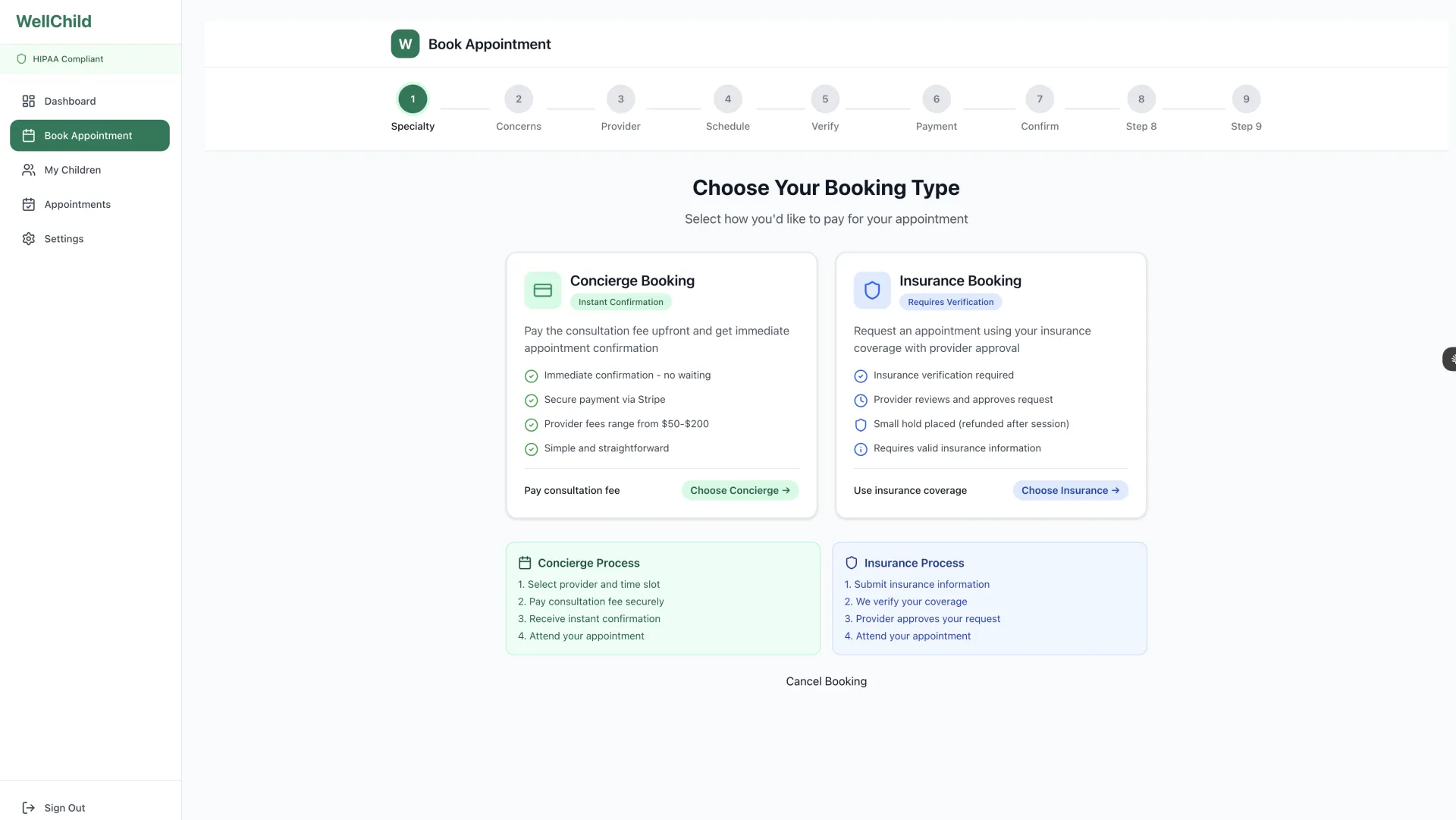
  • Volunteer Profile System — rich pop-up interactions, complete volunteer histories, skill tagging, and certification tracking
  • Document & Media Management — image cropping, organized file storage, and document workflows attached to volunteer records
  • Messaging — streamlined messaging system so volunteer coordinators don’t have to use messy email chains

AI-powered differentiation:

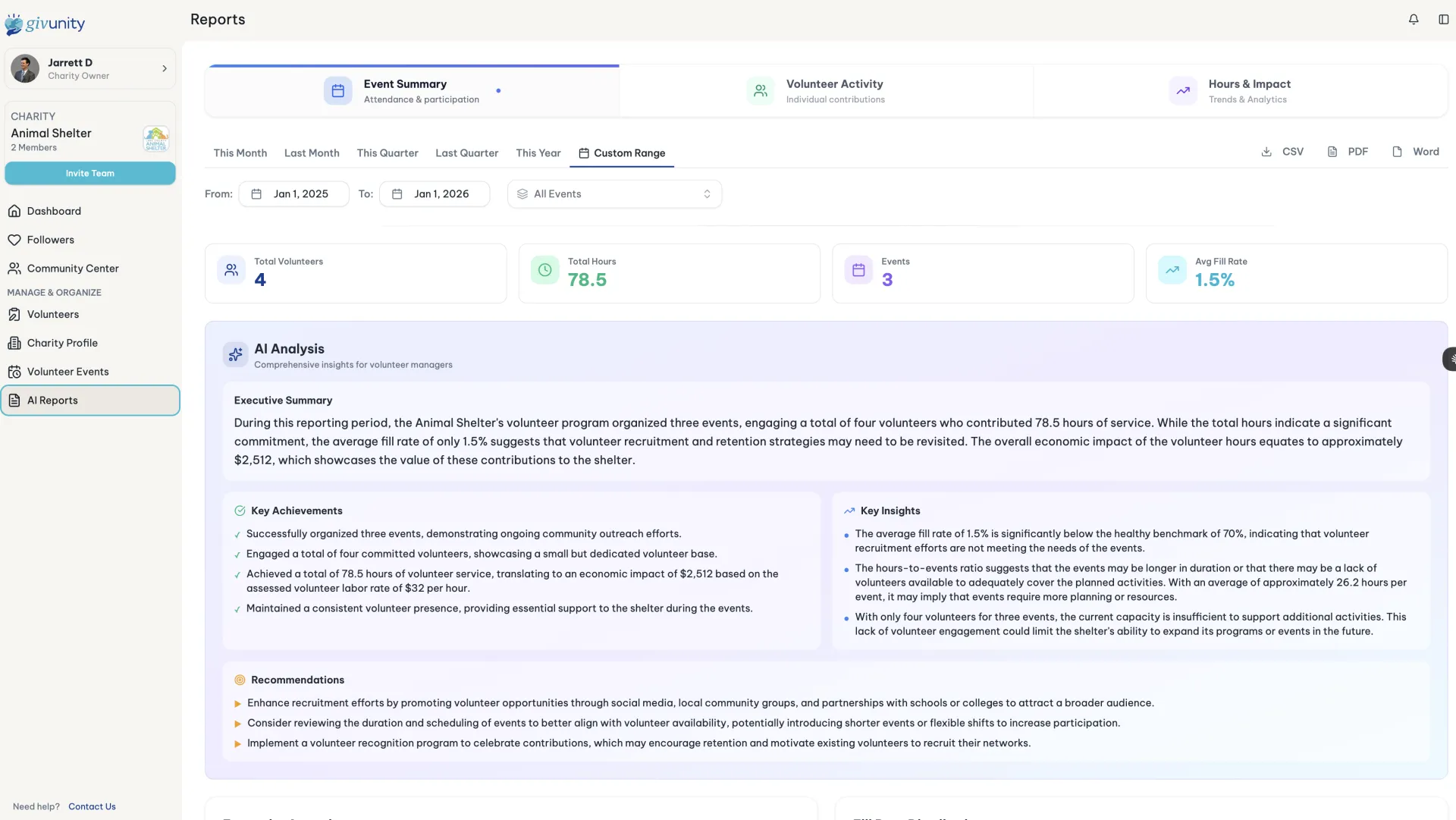
  • AI Volunteer Reports — automated analytics that surface patterns in volunteer data (retention risk, engagement trends, hour anomalies) without a coordinator having to write a single SQL query
  • AI Social Media Builder — branded content generation that helps under-resourced nonprofits maintain a social presence at agency-level polish

These last two are AI-powered features that Givunity’s incumbents don’t offer. They’re also the features a significant investor specifically named as the gating criterion for a funding decision, making the velocity advantage a direct fundraising lever.

The Results

Development Velocity

  • AI Volunteer Reports: 1 month concept to production (industry benchmark: 4–6 months)
  • Multiple feature streams were developed in parallel without quality regression
  • Continuous deployment keyed to live user feedback rather than fixed release windows

Market Traction

  • 400% increase in active users on the platform during the OneChair engagement
  • Cristo Rey Orlando partnership secured for real-world product testing and validation
  • Feature set delivered that would have cost $20K–$75K+ per feature through traditional development channels

Competitive Positioning

Givunity now occupies a position that, on paper, shouldn’t exist: a lean-team platform with the feature depth of a multi-decade incumbent and the AI capabilities of a well-funded challenger.

  • UX quality that rivals and outperforms well-funded competitors like Bloomerang Volunteer and Galaxy Digital
  • AI features larger platforms don’t ship — turning AI from a marketing line item into a real product differentiator
  • Release cadence measured in weeks while competitors release in quarters

Why This Worked: A Comparison

Two ways to build enterprise-grade features for a lean nonprofit-tech startup — and why velocity is the only lever that changes the outcome.

Traditional Agency Build OneChair AI-Orchestrated Build
Time per major feature 4–6 months ~1 month
Cost per major feature $50K–$100K+ Fraction of traditional
Team size required 4–8 specialists Lean, AI-augmented
Feedback-to-ship loop Quarterly Weekly
Parallel feature streams 1–2 Multiple, simultaneous
Risk profile for experiments Each feature is a budget gamble Features become feasible experiments

Key Takeaways

For startups competing with funded players. You don’t need to match their budget — you need to match their velocity. AI-orchestrated development lets lean teams ship features as fast as companies with 10× the resources, which is the only way the unit economics of nonprofit-priced SaaS actually work.

For product development. The build → test → learn cycle is the entire game. When you can go from concept to market-validated feature in a month instead of a quarter, you learn faster, adapt faster, and win faster. Givunity’s investor conversation moved forward because a specific feature shipped — not because it was on a roadmap.

For AI-enhanced development. AI orchestration’s biggest unlock isn’t cost-efficient development — it’s continuous innovation. Features that would have blown the budget become feasible experiments. The strategic question shifts from “can we afford to build this?” to “should we build this?” — and that shift is what changes a company’s trajectory. See how the same approach worked in another lean-team build with identical time-to-market pressure.

Frequently Asked Questions

How long did it take to build Givunity’s AI volunteer analytics?

One month from concept to production, against an industry benchmark of 4 to 6 months for comparable features built by traditional development agencies.

What tech stack powers Givunity?

Next.js 14 for the frontend, NestJS for the API layer, PostgreSQL as the primary datastore, Stripe for billing, Socket.IO for real-time collaboration, and OpenAI for the AI-powered analytics and content generation features.

How does Givunity compare to platforms like Volgistics, VolunteerHub, or Bloomerang Volunteer?

Givunity is purpose-built around AI-assisted workflows that legacy platforms either don’t offer or gate behind enterprise pricing. Where incumbents are strong on tenure and integrations, Givunity is strong on AI-native features, modern UX, and a release cadence measured in weeks rather than quarters.

Can a lean nonprofit-tech team realistically compete with 20-year-old incumbents?

Yes, when velocity is the lever. Givunity’s engagement with OneChair demonstrates that AI-orchestrated development can close a multi-year feature gap inside a single year of focused execution — and add AI-native differentiation the incumbents haven’t shipped.

Is OneChair available for engagements like this?

Yes. OneChair partners with founders building software in healthcare, SaaS, and non-profit categories where speed-to-market is a competitive lever. Book a scope call to find out whether your build is a fit.

READY TO BUILD 97% FASTER?

Book a free scoping call and see how AI-orchestrated development can transform your timeline — and your competitive position.

BOOK A SCOPE CALL