PORTFOLIO ONESPARK BLOG ABOUT FAQ BOOK A SCOPE CALL

5 Days · $5,000 Flat · On Time or It's Free

From idea to clickable product in 5 days. $5K, or your money back.

Real working software you can test, explore, and convince users, clients, and stakeholders — while saving thousands on development cost.

"Looks like 2 months of coding work — he swears it was only a few hours. Oh em gee, I'm blown away."
Joshua Pies, Founder, C47 Films
30-second build reel
5-Day Delivery · $5K Flat · On Time or It's Free · You Own the Code

Here's exactly what you get.

For $5,000 flat, in 5 business days:

  • Working prototype on a live URL
  • Project roadmap
  • Documentation so any developer can understand the code
  • Clean codebase uploaded to your repo
  • Not throwaway code
  • Senior engineers on every build

Miss the date by one day? Full refund — and we still give you the prototype. The entire $5,000. Back in your account.

The OneChair Difference

Built by people who've shipped real software.

Senior engineers oversee every build. The same team that delivers software for big enterprises reviews your prototype.

A live platform.

We give you a URL link you can click through and test with users. It looks and feels like a real product because it is the start of one.

You own it.

Take what we build to anyone — investors, potential co-founders, another developer. No platform lock-in. No strings.

Built by OneSpark.

Our own AI development system, trained on 20 years of delivering enterprise software to Fortune 500 and Global 1000 companies. Code that follows real enterprise standards.

How It Works

01

Book a Call

30 minutes. You tell us what you want to build. We confirm it fits. If we're aligned, you commit and we lock the requirements call.

02

Requirements Workshop

A 2-hour deep dive. Every screen, every feature, every detail mapped with you. The 5-day clock starts when we close the call.

03

Delivery in 5 Business Days

A live link to working software. The code is yours, and a review call. Miss the date? Full refund.

The Guarantee

Late by even one day? Full refund.

$5,000 flat. 5 business days. No setup fees. No surprises.

If we miss the date by one day, you will get a full refund and the prototype.

We can offer this because OneSpark and our development team always deliver on time and in full.

Don't take our word for it.

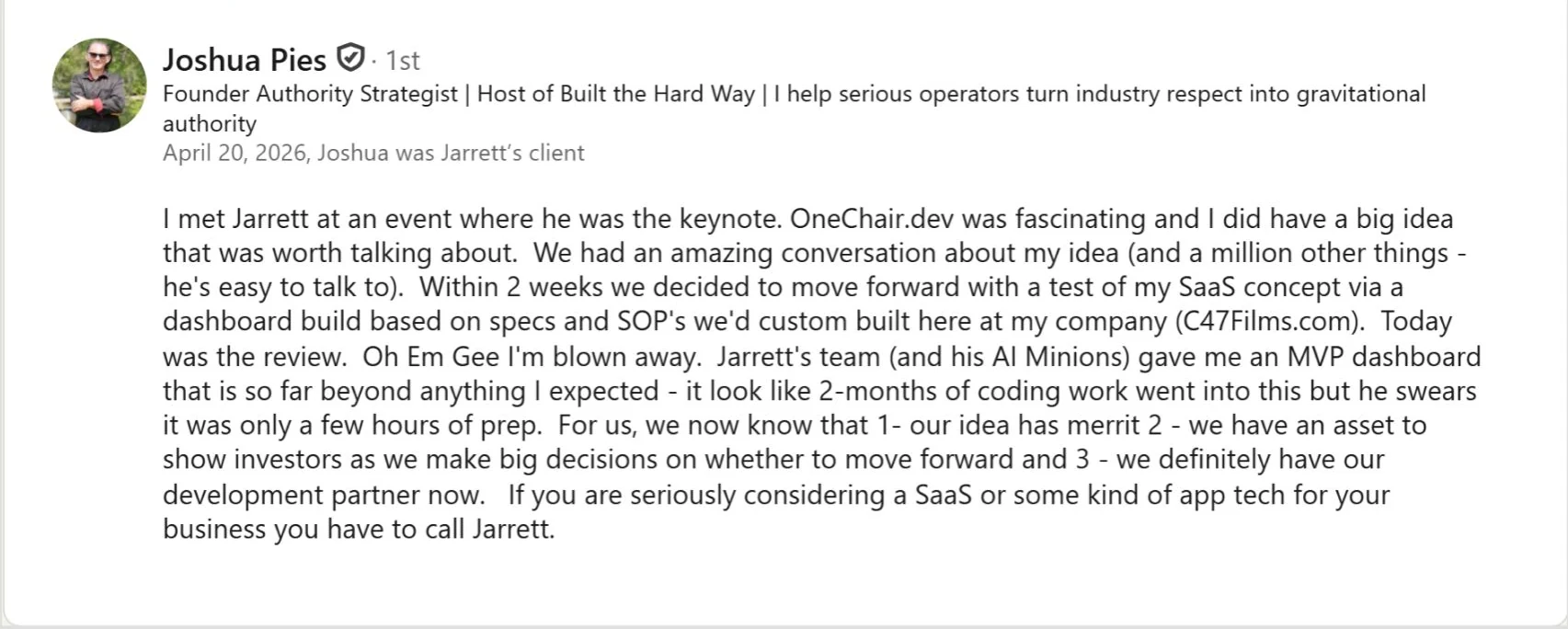
"I met Jarrett at an event where he was the keynote. Within 2 weeks we decided to test my SaaS concept via a dashboard build. Today was the review. Oh em gee I'm blown away. It looks like 2 months of coding work went into this but he swears it was only a few hours of prep. We now know 1) our idea has merit, 2) we have an asset to show investors, and 3) we have our development partner. If you are seriously considering a SaaS or some kind of app tech for your business, you have to call Jarrett."
Joshua Pies
Founder, C47 Films
LinkedIn
"I talked to Jarrett about my idea and in a few days my idea has come alive. I couldn't be more impressed by the quality and speed of the prototype. It created something I can actually show people. I have used the prototype to run user testing, form our founding team and generate investor interest. Without OneChair, I am not sure if the idea would have ever got off the ground. It has created real momentum for Homebaked."
Valerie Uy
Founder, Homebaked
LinkedIn

Ready to See Your Idea Working?

Tell us what you're building. We'll review your submission, confirm fit, and book your scope call. $5,000 flat. 5 business days. Full refund if we're late.

Common Questions

It's real working prototype. You click buttons, things happen, screens change. The data is test data — we don't connect to your real systems yet — but the experience is real. Show it to investors, users, or your team and help decide what you want to build next.

We currently haven't run into a project that was too big for 5 days. If it is, we catch that on the scope call. If your idea is bigger than a 5-day sprint, we'll tell you up front and either narrow the scope to something we can ship in 5 days, or propose a longer engagement. We don't take projects we can't deliver.

Most of our prototype clients aren't. You don't need to know what a database is or how code works. You tell us what you want it to do; we make it do that.

Yes. The code, the design, the work — all yours. Take it to any developer in the world and they can keep building on it. No platform lock-in. No proprietary anything.

Because OneSpark lets us deliver fast without cutting corners. We make our margin on speed — not by overcharging you.

You get all your money back and the prototype. The full $5,000 returns to your account. We've delivered many prototypes and haven't missed yet, but if we ever do, you're protected.

It's yours. Most clients keep building with us, but that's their choice. You're free to take what we built anywhere.

Case Study · Homebaked

From idea to founding team in 5 days

The vision

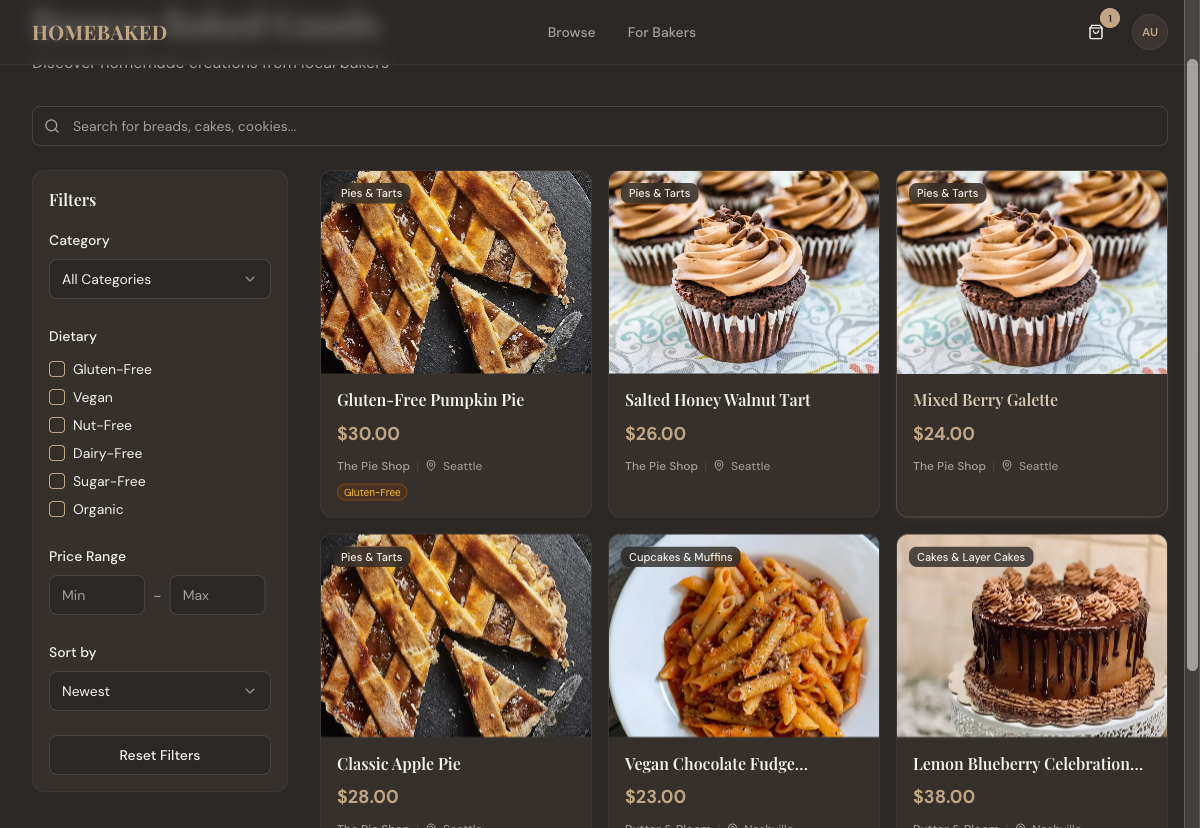
Valerie Uy had been thinking about Homebaked for a while. The idea was simple but underserved: a marketplace that connects home bakers with their local communities — giving talented hobbyist bakers a way to turn their craft into income, and giving customers access to fresh, locally-made baked goods they couldn't find anywhere else.

The vision was clear. The path to getting there was not.

The challenge

Like most first-time founders, Valerie ran into the early-stage paradox almost immediately. To attract co-founders, she needed something more than a deck. To get useful feedback from potential users, she needed something they could actually interact with. To open conversations with investors, she needed proof the idea was more than just a concept.

But to build any of that, the traditional path meant hiring developers, spending $20,000+ to $50,000, and waiting three to four months for an MVP — all before knowing whether the core idea even resonated with bakers and buyers.

It was the classic problem: she needed traction to build the product, and she needed the product to get traction.

"I had this idea I believed in, but every conversation hit the same wall. People wanted to see it. And I didn't have anything to show them."

Valerie Uy

The conversation

Valerie reached out to Jarrett at OneChair to talk through her options. The pitch was straightforward: instead of spending months and tens of thousands of dollars building an MVP that might miss the mark, what if she had a fully interactive prototype in five days — something realistic enough to run user tests, pitch to investors, and use as a recruitment tool for co-founders?

The price was flat. The timeline was guaranteed. If OneChair was late by even a day, every dollar came back.

Valerie signed on.

What we built

In five days, OneChair delivered a fully interactive prototype of the Homebaked marketplace. The scope covered the core experience end-to-end:

  • Baker profiles and storefronts
  • Product discovery and browsing
  • The ordering and checkout flow
  • The baker onboarding and sign-up journey
  • Customer-facing search and filtering

The prototype was high-fidelity and clickable — close enough to a real product that users testing it would forget they weren't using a live app. It was also exportable, so Valerie could share it with anyone, anywhere, without needing OneChair in the loop.

The goal wasn't to build software. It was to build certainty — to give Valerie a tool she could use to answer the questions that were blocking her progress.

How Valerie used the prototype

What happened in the weeks after delivery is where the real value showed up. Valerie didn't just have a prototype sitting in a folder — she had a Swiss Army knife for moving Homebaked forward on multiple fronts at once.

1. User testing that shaped the product

Valerie ran the prototype past home bakers and potential customers, watching how they navigated the experience and where they got stuck. Some of what she learned confirmed her assumptions. A lot of it didn't.

The sign-up flow needed simplification. The way bakers presented their offerings needed more flexibility. Discovery needed to lean harder on locality and trust signals. These were the kinds of insights that would have cost weeks of developer time to course-correct if she'd built first and tested later.

Instead, she had directional clarity before any code was written.

2. Forming a founding team

Possibly the most underrated outcome: the prototype became Valerie's recruitment tool. Building a startup alone is hard, and convincing talented people to join an early-stage idea is harder. A deck describes a vision. A working prototype demonstrates one.

When Valerie showed potential co-founders what Homebaked could look and feel like, the conversation shifted. Instead of "would you be interested in this idea?" it became "would you want to build this?"

It worked. The Homebaked founding team came together off the back of those conversations.

3. Generating investor interest

With a tangible product to demo, investor meetings stopped being theoretical. The prototype let Valerie walk early-stage investors through the actual user experience — the same experience real users had already tested and given feedback on.

This changed the texture of every conversation. Instead of investors asking "is this idea real?" they were asking "how does this scale?" — a much better question to be fielding.

The outcome

In the months that followed the 5-day sprint, Homebaked moved from concept to active venture:

  • A validated product direction, grounded in real user feedback
  • A founding team, recruited with the prototype as the centerpiece
  • Active investor conversations and tangible momentum
  • Tens of thousands of dollars in development costs deferred until the right time
  • Months of build time avoided

But the deeper outcome is harder to put on a metrics list: Valerie had something real. Every conversation about Homebaked — with users, with potential teammates, with investors — was now anchored in a tangible thing instead of a description of one.

In Valerie's words

"I talked to Jarrett about my idea and walked out five days later with something I could actually show people. I have used the prototype to run user testing, form our founding team and generate investor interest. Without OneChair, I am not sure if the idea would have ever got off the ground. It has created real momentum for Homebaked."

Valerie Uy, Founder, Homebaked

Why this worked

Homebaked is a clear example of why prototyping has become essential for early-stage founders. The cost of being wrong about your product — building the wrong thing, hiring developers too early, raising on an unvalidated thesis — has only gone up. The cost of finding out whether you're right has gone down dramatically.

Five days and a fixed fee gave Valerie what would have taken two months and $30,000+ to learn the old way: whether the idea was worth building, what shape it should take, and who should help her build it.

That's not just cost savings. That's optionality. That's momentum. That's the difference between an idea that stalls and one that gets off the ground.


Case Study · Podtelligent

Validating a business podcast network in a single sprint

The meeting

Joshua first crossed paths with Jarrett at an industry event where Jarrett was delivering the keynote. The talk was about a problem Joshua had been wrestling with for months: how do you test whether a software idea is worth pursuing — without burning tens of thousands of dollars and half a year finding out?

As the founder of C47 Films, Joshua had spent years inside the world of professional video and audio production. He'd watched business podcasting evolve from a fringe marketing tactic into one of the most influential channels in B2B and he'd noticed something the existing platforms hadn't solved for. Business listeners didn't have a dedicated home. The shows they wanted were scattered across general-purpose podcast apps, buried under true crime and celebrity interviews, with no real way to discover the founders, topics, or threads that mattered to them.

That gap became Podtelligent: a discovery platform and network built specifically for serious business podcasts and the operators, founders, and investors who listen to them.

Joshua believed in the idea. What he didn't have yet was a way to prove out the concept before making a big investment.

Two weeks after the keynote, he and Jarrett were scoping a prototype.

The challenge

SaaS founders face a specific version of the early-stage trap. Unlike a consumer app, where a landing page and a waitlist can hint at demand, a platform product has to show its work. The interface is the product. Early-stage investors want to see the experience. Future users want to understand what they'd actually be using day-to-day. Engineering hires want to see what they're being asked to build.

Without an interface to point at, every conversation stays abstract. And abstract conversations don't move anything forward.

Joshua needed three things, fast:

  • Internal conviction that Podtelligent had real product-market fit potential
  • A demoable asset for investor conversations
  • Enough clarity on the product to choose a development partner with confidence

The traditional path — hire a designer, hire developers, spend two months and tens of thousands of dollars building a working version — would have answered those questions eventually. But by the time the answers came in, the cost of being wrong would already be sunk.

What we built

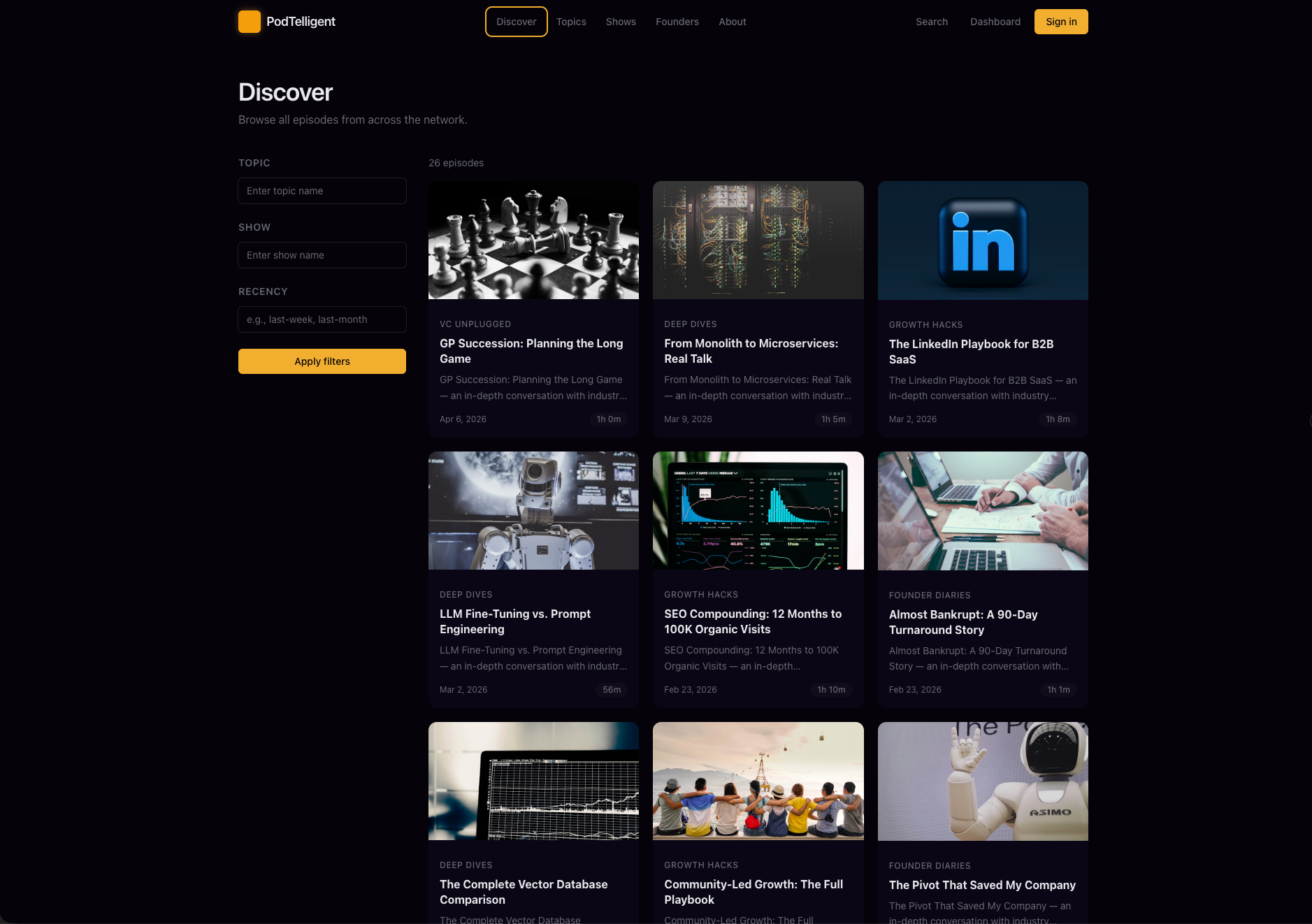
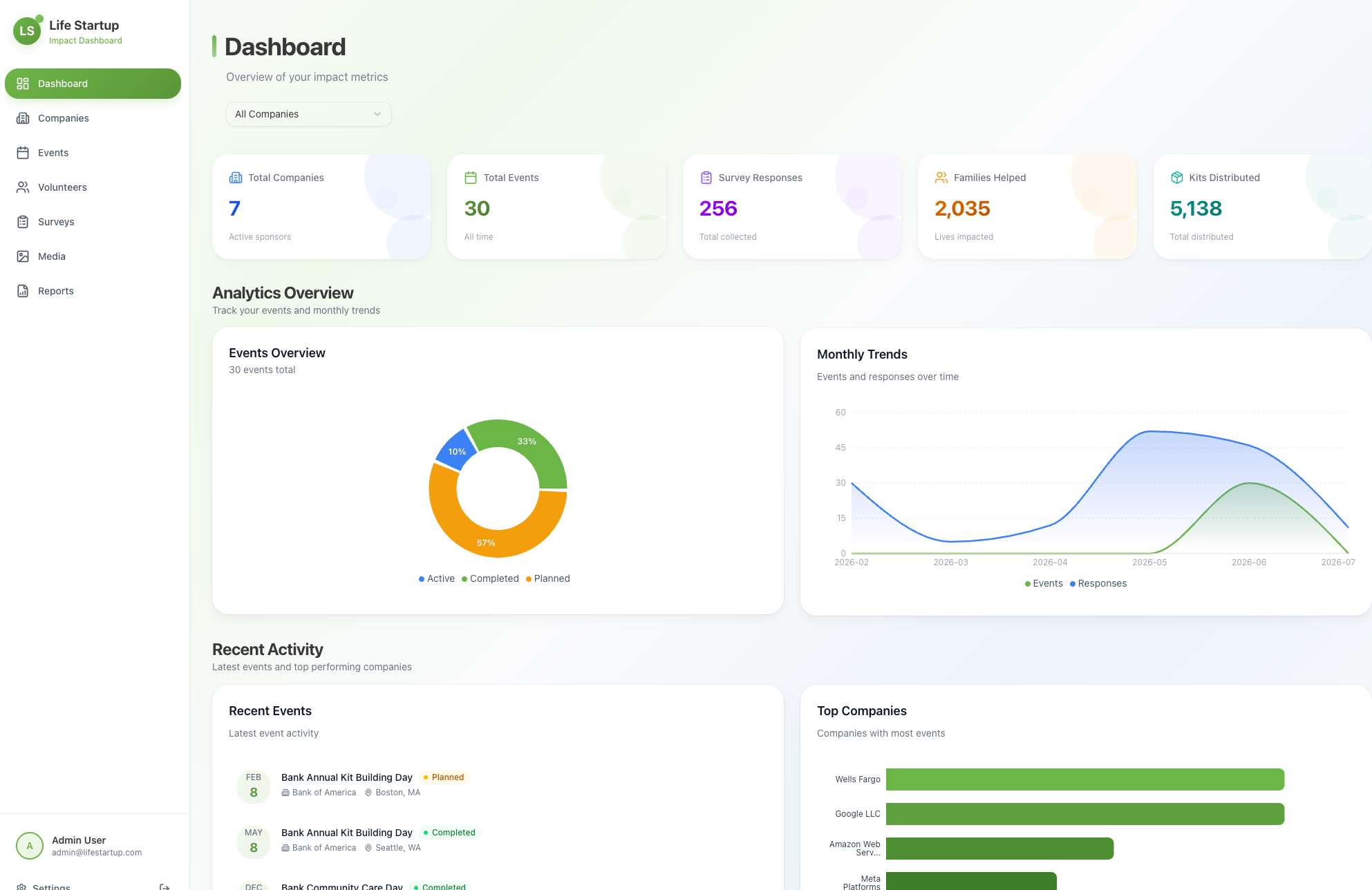
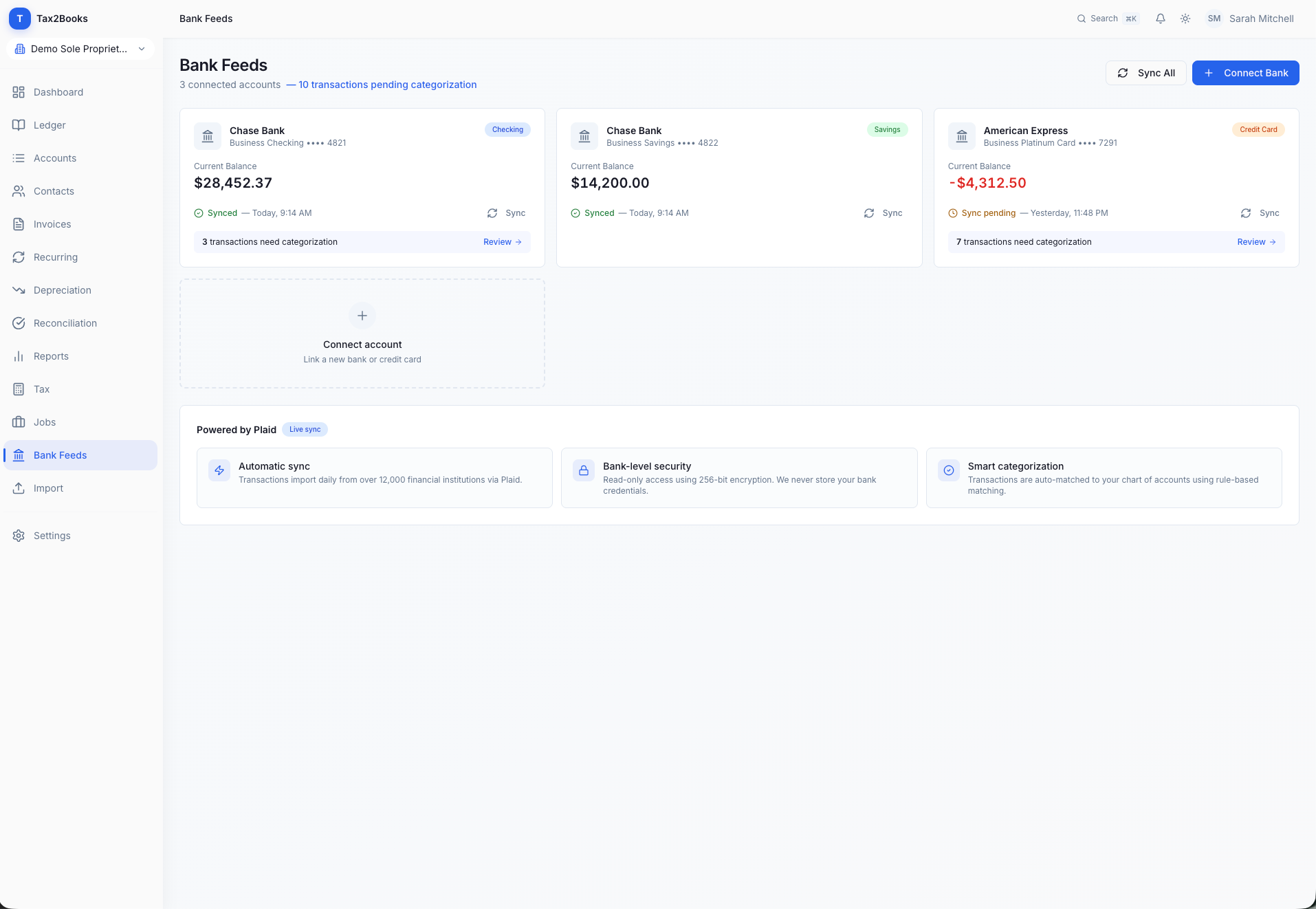
OneChair scoped and delivered a high-fidelity, fully interactive prototype of Podtelligent — the discovery experience, the topic threads, the founder profiles, the dashboard, and the listener library all brought to life as a clickable, demoable product.

The fidelity matters here. This wasn't a wireframe or a mood board. It was a platform that looked and behaved like a real piece of software — the kind of asset you can put in front of an investor without explaining what they're looking at, or hand to a developer as a reference for what to build.

What made the build remarkable wasn't just the output. It was the input. The prototype came together in a few focused hours of prep work, leveraging the systems and patterns OneChair has refined across previous sprints. To Joshua, reviewing the result, it looked like two months of coding.

"It looks like 2 months of coding work went into this but he swears it was only a few hours of prep."

Joshua Pies

That gap — between what it looks like and what it cost to produce — is the whole point.

The review

When Joshua sat down for the review, the reaction was immediate.

"Today was the review. Oh em gee I'm blown away."

Joshua Pies

The prototype wasn't just a proof of concept. It was a product Joshua could see, click through, and imagine listeners and podcasters actually using. The abstract idea he'd been holding in his head for months was suddenly something he could share with other people — and they'd get it without needing the long version of the pitch.

Three things became clear in that review:

  1. The idea had merit. Seeing Podtelligent rendered as a real product, Joshua could finally evaluate it the way his future users would. The answer was yes — this was worth building.
  2. He had an investor-ready asset. No more pitch decks trying to describe an interface in bullet points. He could now demo the product itself.
  3. He had found his development partner. The prototype sprint wasn't just a deliverable — it was an audition. Joshua came out of it confident that OneChair was the team to build the real thing.

"We now know 1) our idea has merit, 2) we have an asset to show investors, and 3) we have our development partner."

Joshua Pies

The outcome

In a single sprint, Joshua went from "I have an idea I believe in" to "I have a validated concept, a demo-ready asset, and a team to build it." Each of those, individually, can take months for a founder to figure out. Together, they represent the difference between an idea that lingers and one that moves.

The cost of getting all three through traditional development channels — designer, engineering team, multiple months of work — would have been an order of magnitude higher, and with no certainty at the end of it that the original idea was worth building in the first place.

This is the inversion that prototyping makes possible: instead of spending months and a fortune to find out if your idea works, you spend days and a fixed fee to know before you invest further.

In Joshua's words

"I met Jarrett at an event where he was the keynote. Within 2 weeks we decided to test my SaaS concept via a dashboard build. Today was the review. Oh em gee I'm blown away. It looks like 2 months of coding work went into this but he swears it was only a few hours of prep. We now know 1) our idea has merit, 2) we have an asset to show investors, and 3) we have our development partner. If you are seriously considering a SaaS or some kind of app tech for your business, you have to call Jarrett."

Joshua Pies, Founder, C47 Films

Why this worked

Joshua's story illustrates something specific about SaaS and platform validation that founders often underestimate: the interface is the pitch. You can describe a marketplace, a service business, or a physical product in words. You can't really describe software — not in a way that lands. Software has to be seen, clicked, and felt.

A prototype collapses the distance between idea and demonstration. It turns "let me explain what we're building" into "here, try it." And that shift changes every downstream conversation — with co-founders, with investors, with development partners, with future users.

For SaaS founders especially, prototyping isn't a nice-to-have. It's the fastest, cheapest, lowest-risk way to find out whether the idea in your head is worth the years of work it'll take to bring it to market.

Joshua found out in a single sprint. So can the next founder.